Contents

2016년 9월 29일 목요일

[Reading-B2] 스마트폰과 어플, 한국 여행 앱 : Smartphone and application, Korea travel app


[ Reading-B2 : Reading for Beginners 2]

스마트폰과 어플, 한국 여행 앱 : Smartphone and application, Korea travel app


1) 한국 사람들과 스마트폰 : Korean people and the smartphone


지하철 안 한국 사람들 (Korean people in subway)
출처 (Image source link)

지하철 안 한국 사람들 2 (Korean people in subway 2)
출처 (Image source link)

 한국인은 스마트폰을 많이 사용합니다. 집, 학교, 회사, 지하철, 버스, 차 그리고 길에서도 스마트폰을 사용합니다. 전 세계 성인 43%가 스마트폰을 사용하는데 한국 성인 88%가 스마트폰을 사용한다고 합니다. 18세부터 34세까지 사람들은 모두 스마트폰을 사용하고 있고 35세보다 나이가 많은 사람들은 83%가 스마트폰을 사용합니다.
 한국 사람들은 스마트폰으로 무엇을 할까요? 한국 사람들이 스마트폰으로 가장 많이 하는 것은 ‘인터넷 검색’입니다. Wi-fi만 있으면 스마트폰으로 인터넷을 사용할 수 있습니다. 그래서 스마트폰을 사용하면 편하게 인터넷 검색을 할 수 있습니다. 한국에는 Wi-fi를 사용할 수 있는 곳이 많습니다. 그래서 한국 사람들은 컴퓨터보다 스마트폰을 사용해서 인터넷 검색을 많이 합니다. 두 번째로 많이 하는 것은 ‘SNS’입니다. 카카오톡, 페이스북, 트위터 등 한국 사람들은 다양한 SNS를 많이 사용합니다. 그리고 세 번째로 많이 사용하는 것은 ‘시계’입니다. 한국 사람들은 스마트폰을 많이 가지고 있습니다. 그래서 시계를 보지 않고 스마트폰을 보고 시간을 확인합니다. 특히, 많은 한국 사람들이 스마트폰을 주머니에 넣지 않고 손에 들고 있습니다. 그래서 시계처럼 시간을 확인할 수 있습니다.


* 단어 : Word 

- 성인 : (noun) adult
- -세 : counting noun for age, respectful way to say ‘-살(= counting noun for age)’
- 인터넷 검색 : (noun) Internet surfing
- 사용하다 : (action verb) to use
- 다양하다 : (stative verb) to be various
- 시계 : (noun) clock, watch
- 가지고 있다 : (phrase) to have
- 보다 : (action verb) to see, to look
- 시간을 확인하다 : (phrase) to check the time
- 주머니 : (noun) pocket
- 들다 : (action verb) to hold, to carry
- 편하다 : (stative verb) to be comfortable
- ~처럼 : (particle) like ~


2) 외국인을 위한 한국 여행 앱 Visit Korea : Korea travel app for foreigners 'Visit Korea' 


Visit Korea 로고 (Visit Korea Logo)
출처 (Image source link)

구글 플레이(Google play)의 Visit Korea 다운로드 페이지
(Visit Korean download page in Google play)
출처 (Image source link)


 많은 사람들이 스마트폰을 사용합니다. 휴대폰의 ‘어플리케이션(application)’을 한국 사람들은 ‘어플’이나 ‘앱’이라고 합니다. 사람들은 앱을 다양한 상황에서 사용합니다. 그래서 현재 다양한 어플이 만들어지고 있습니다. 앱을 사용하면 게임, 쇼핑, SNS, 인터넷 검색 등 다양한 것들을 할 수 있습니다. 여행을 할 때도 앱을 사용합니다. 좋은 어플에는 많은 여행 정보가 있기 때문입니다.
 한국을 여행하는 외국인들에게 유명한 앱이 있습니다. 그 앱의 이름은 Visit Korea입니다. Visit Korea에는 한국 여행을 할 때 필요한 정보가 많습니다. 한국에서 여행할 수 있는 곳과 볼 수 있는 것들, 호텔, 유명한 음식과 음식점, 쇼핑할 수 있는 곳과 살 수 있는 것들을 알 수 있습니다. 그리고 버스, 지하철, 기차, 택시, 공항 정보를 알 수 있습니다. 이 앱으로 한국 지도도 볼 수 있습니다. 그리고 내가 가고 싶은 곳을 가는 방법도 알 수 있습니다. 또한 Visit Korea로 한국어를 공부할 수 있습니다. 한국을 여행할 때 필요한 표현을 연습할 수 있기 때문입니다. 

* Visit Korea 앱은 여기에서 다운받을 수 있어요!
 (These are the site links to download 'Visit Korea' app. Click if you are interested in downloading them!)


* 단어 : Word  

- 휴대폰 : (noun) cell phone
- 상황 : (noun) situation
- 만들어지다 : (action verb) to be made
- 여행 : (noun) travel
- 여행하다 : (verb) to travel
- 유명하다 : (stative verb) to be famous
- 정보 : (noun) information
- 등 : etc
- 필요하다 : (stative verb) to be necessary
- 지도 : (noun) map
- 방법 : (noun) method, way
- 또한 : also


Have a class with a native Korean teacher!
[Click the image]


2016년 9월 22일 목요일

[Reading-B2] 치킨을 사랑하는 한국 사람들 : Koreans who LOVE the chicken


[ Reading-B2 : Reading for Beginners 2]

치킨을 사랑하는 한국 사람들 : Koreans who LOVE the chicken


1) 한국 사람들의 치킨 사랑 : Korean's love for chicken


치킨 : Fried chicken (출처 : Image source)
양념 치킨 : Chicken with sauce (Seasoned fried chicken)

 닭을 기름에 튀긴 것을 ‘치킨’이라고 합니다. 치킨은 바삭바삭하고 맛있습니다. 그래서 많은 사람들이 치킨을 좋아합니다. 한국 사람들은 치킨을 정말 좋아합니다. 한국 사람들은 치킨을 ‘치느님’이라고 합니다. ‘치느님’은 ‘치킨’과 ‘하느님’을 합친 단어입니다. ‘하느님’은 한국어로 ‘신’을 의미합니다. 한국 사람들이 치킨을 너무 좋아해서 치킨을 ‘신’이라고 부르는 것입니다.
 한국에는 치킨을 파는 가게가 많습니다. 2016년 현재 한국에는 치킨 가게가 3만 6천개가 있고 전 세계 맥도날드 매장은 3만 5천개가 있습니다. 한국에 있는 치킨 가게가 전 세계에 있는 맥도날드 매장보다 천 개 더 많습니다. 한국 치킨 가게는 ‘배달 서비스’도 합니다. 그래서 한국 사람들은 치킨을 편하게 먹을 수 있습니다. 전화를 하면 가게에서 치킨을 집까지 가져다주기 때문입니다.

* 단어 : Word 

- 닭 : chicken
- 치킨 : fried chicken
- 신 : god
- 튀기다 : to fry
- 부르다 : to call
- 합치다 : to combine
- 바삭바삭하다 : to be crispy
- 가게 : store
- 매장 : shop
- 전 세계 : the world
- 배달 : delivery
- 서비스 : service
- 가져다주다 : to bring (something for someone)


2) 같이 '치맥'할까요? : Will you do 'Chimak' with me?


치맥 (치킨 + 맥주) : Chimak (Chicken and beer)
(출처 : Image source)

 ‘치맥, 1인 1닭’은 치킨 때문에 만들어진 단어들입니다. 한국 사람들이 치킨을 많이 먹고 좋아하기 때문에 새로운 단어를 만든 것입니다. ‘치맥’은 치킨과 맥주를 같이 먹는 것입니다. ‘치킨과 맥주’를 같이 먹기 때문에 ‘치맥’이라고 합니다. 치맥은 인기가 많습니다. 그래서 한국에는 ‘치맥 페스티벌’도 있습니다. 한강에 가면 ‘치맥’을 먹는 사람들을 많이 볼 수 있습니다.
 치킨을 너무 좋아하는 사람들은 혼자 치킨 한 마리를 다 먹고 싶어 합니다. 다른 사람과 같이 치킨을 먹으면 치킨을 많이 먹을 수 없습니다. 그래서 치킨을 좋아하는 사람들은 한 사람이 한 마리의 치킨을 먹습니다. 이렇게 한 사람이 치킨 한 마리를 다 먹는 것을 ‘1인 1닭’이라고 합니다.

* 단어 : Word  

- 맥주 : beer - 새로운 : (adj) new 
- (A) 때문에 : because of (A)
- 너무 : very
- 만들어지다 : to be made
- 혼자 : by oneself


Have a class with a native Korean teacher!
[Click the image]


2016년 4월 2일 토요일

[Korean CSI] Letters before Hangeul, Songs before tales : Male cinderella and The disease shielder


[ Korean CSI : Korean Culture, Sightseeing, and Illustration ]
Letters before Hangeul, Songs before tales
- Male cinderella and The disease shielder -


Drama Seodongyo
: Image from Daum movie
 
Drama Chuyong season 1, 2 : Image from Google page

  How many images can you recognize? These are posters from separate K-dramas.  First one is a poster from the drama 'Seodong-yo' - The song of Seodong. (SBS channel, 2005-2006) Other two posters are from the drama 'Chuyong, the detector who sees ghosts'. (OCN channel, 2014(Season 1), 2015(Season 2))
 You might know one or both of the dramas or neither of them. Thus, if you had watched at least one of them, you will agree with me that these are quite 'watchable' dramas. The actual numbers, ratings, also shows that they are. Average ratings for each drama are around 15-20%, which is not bad grade in Korea. Especially the second drama, 'Chuyong' was quite a hit on cables with two seasons and fans are now waiting for the third.
  These two dramas have one thing in common. The main idea, Seodong and Chuyong, of two dramas are based on the 'old songs' that were made around 7-9c. These two songs also have some interesting 'tales' that came along with them. These are the dramas that might not even 'existed', if there are no songs nor tales that these dramas can 'imitate'. Thus, if we think differently, these dramas won't be even made in the first place if those songs and tales are not interesting enough to get people's attention. So, how did they, the tales, had persuaded people to 'transform' themselves into dramas? What kind of unique characteristics the stories have that draw so many people's attention?

1) The song of Seodong(서동요) : A smart way to be a 'male cinderella'. 


Drama Seodongyo
: Image from the site link
  Did you know that 'cinderella story' was not just the cliche that was used in modern dramas? The well-known story of cinderella is and was another 'cliche' that is commonly used in K-dramas; in any other 'romcom' genre. However, it didn't gain its fame in modern society. The song of Seodong and the tale behind it is the proof. However, the tale of 'Seodong' is slightly different from the 'modern' cinderella. Because he is 'male' and not the 'female' like the cinderella from the Diseny movies. Not only that, he didn't need any fairy or genie to help him to elevate his class. In his story, a 'song' did all the work to let him become a 'king' from a not-very-special 'yam seller'.
  Let's first see how 'great' the song was.  

The song of Seodong : Image made by Teacher Havina
  Can you feel the smell, or maybe an 'odor', of the gossip leaking from the song? If you do, you are correct. This song was made 'on purpose' to leak those 'odor' that you are smelling right now.
  Story begins with Seodong, the 'yam seller', living with his single mother in the country called 'Baekjae'. Though he seemed normal, he was not 'purely' normal. Because he was a son between a human woman and a dragon from the pond - remember, this is a 'tale'. - near to his house. So he was clever and brilliant from the very young age.


Seodongyo Theme park ( Drama set )
: Image from the site link

  One day, Seodong heard that there is a gorgeous princess Seonhwa - the youngest, the third, daughter of the king Jinpyeong - had no person to marry. She was a princess from a neighboring country, Shilla. He traveled all the way to that country to meet her. However, she was a princess, there was no way for him, a normal young man, to meet her. Thus, he wasn't disappointed. He thought night and day to think of a way to meet her. Then he made a song - that you just read - and start to sing it on the road. It must be a song with a good rhythm and beat, because all of the kids start to sing along with him. If this didn't work to some of the kids, he gave away the 'yam' to them to teach this song and encourage them to sing the song on the road.


Seodongyo Theme park ( Drama set)
: Image from the blog link
Seodongyo Theme park ( Drama set)
: Image from the blog link

  You know how powerful the kids are, right? They are like the 'trend-makers'. It was not so different in the past. Soon, the people in the country know about this song, and of course, the king as well. King was furious about this rumor and exile the princess out of the castle. It seems like he believed this song too much too soon, but this was nothing but the benefit for Seodong. While the princess was heading to the place for her exile, Seodong intercepted her. She oddly attracted to him and fell in love with him in short term and married him eventually. Seodong became rich and famous after coming back to his hometown; became a king of Baekjae. Happy ending like all other Cinderella story, even the male one.
  More interesting fact is, the main character, Seodong is based on a real-life character. This is a story of the king 'Mu', one of the most powerful and clever king, from Baekjae, this country was existed from B.C 1 to 7c. The story itself is considered as a 'fake', but recently there was several proof, the bones of a woman and the pottery from Shilla from one of the king's tomb of Baekjae. This shows this story might be, and can be 'true'.

Seodongyo Theme park ( Drama set )
: Image from the blog link

  There is even a 'Seodongyo Theme park (On set : Seodongyo)' in Korea, since this romance story was so famous in Korea. This theme park was once used as a drama set of the drama Seodongyo, but now it is preserved and opened to the public as a theme park. It is about 33,000 square meters large, and has buildings that reproduced the old villages, houses, markets and castles of Bakjae and Shilla. You can see, feel and experience 'The old days of Korea' while walking around the park. Not only the drama Seodongyo but also the drama 'The Legend (Taewangsashingi), Daepungsu, Gyebaek (General Gyebaek), The slave hunters (Chuno) , Dong-e' was taken on this theme park. If you want to know more about the theme park, you can visit THIS SITE LINK(Visitkorea.or.kr) to know more about the theme park.

2) The song of Chuyong(처용가) : My wife is cheating, but I'm cool with that.


The mask of Chuyong
: Image from the blog link

  I have a short question to the male readers : how will you react when you find your wife is cheating on you? Some of you might get furious and some of you will choose divorce. But here is a guy who is extraordinarily 'cool' with this situation.
  One day, a man named Chuyong came back from a party. When he arrived at his house, he realized there are one more pair of 'shoes' that he had never seen before. He opened the door, and voila. Under the blanket, there were more than two legs he can see.
  He came out from the room. He clearly saw the 'four legs' but he just stepped out of the room. Instead of being furious and start to express the anger, he start to sing a impromptu song. Here is a 8 line song that he had made on that very spot.

The song of Chuyong : Image made by Teacher Havina

  Name anything : cool, pitiful, ridiculous, absurd, literally anything. But he did. He literally made his situation into a 'song', just like some of our pop stars do - this is not so 'new' trend, right? A trend of making the song about the singer's current status had already begin from 9c, the time that this song has first made.
  Though, unlike the pop starts cannot get their lovers back or any apologize from the ones they got hurt from, Chuyong had win both of them just with his song. After he finished singing the song, the cheater had ran out from the room, begged for the forgiveness and promised him never to come back to his house. Chuyong, this generous and peaceful guy, had forgiven the cheater and won his wife back again.
  This must be quite abnormal, and weird love story you've ever read. Thus, there is a reason for it. I bet most of you had thought this 'cheater' was just another 'person'. However, what if the cheater is not a 'person'? This story has a deeper explanation than just another 'love-triangle'.
   Chuyong was not a normal person; he was a seventh son of 'Sea king' - again, this is a 'tale'. The cheater was also not a person; he was a 'God of disease'. Therefore, to look at the story once again, basically the wife of Chuyong wasn't 'cheating', she was 'ill'. Chuyong sang the song to drive him out and the disease finally disappeared. Now, this version of commentary makes a lot more sense, doesn't it?

The face of Chuyong
: Image from the blog link
  There is also an interesting custom in Korea, based on this story. The god of disease, cheater, had promised Chuyong not to come back to his house. Therefore, in the past, people attached the picture of Chuyong's face on their gate, to make the god of disease to mistaken the house as the Chuyong's house and not to let him come into their house. This was a 'talisman' that Korean people had used in the past to prevent their family members to get disease.
  How about putting his face on your door too? Who knows? The picture might work and protect you from having any kinds of disease. :P
 P.S. ( Plus Story ) 
 Letters before Hangeul : Idu (이두), Gugyeol (구결), Hyangchal (향찰)


  Some of you might wonder why the 'Original song' for both songs are written in Hanja. Some of you might 'misunderstand' that these songs are the ones that are originate from China, which is NOT. So, to prevent this kind of misunderstanding, I will briefly explain about the writing system that was used in the past, even before Hangeul.
  Hangeul, the current Korean alphabet, was not the first letter that Korean people had used. It hadn't became a 'national' letter until 1913. The name of the letter, Hangeul, was also first named in 1913 by the Korean scholar 'Si-gyeong Joo'. Before then, the name of the letter was not even Hangeul, it was Hunminjungeum.
  Then what kind of 'other' letters that Koreans had used before using Hangeul?
  Just like any other asian countries that are near to China, Koreans also used Hanja as their letters. However, this Hanja was read and written in 'Korean' way. The pronunciation and the usage of hanja are different from China. The results of these differences are Idu, Gugyeol and Hyangchal. However, I won't explain the detail rules of the system. Because it will only cause a headache to show you the sentences like :
本矣吾下是如馬於奪叱良乙何如爲理古
and explain about the differences has been made in sentence structure to use Chinese Hanja in 'Korean way'. Instead, I just want to 'mention' and 'introduce' to you that there were different kind of letter system before Hangeul was made.
  Idu was made around 7c by the monk named 'Seolchong'. It was mostly used for documents that are used in real-life such as official documents for government. It has also been used for written messages for communication like letters and literary writings, but mostly it was used for official documents. It was quite popular among people so it was used until 19c even after the Hangeul was made and used by people.
  Gugyeol is is the form that has evolved from 'Idu'; become more similar to Korean than Chinese. The basic rule of Gugyeol and modern Korean is just the same. So this method of writing that is still used modern Korean. The form of Gugyeol can be seen in newspapers or scholar writings or other writings that both use Hanja and Korean even until now.
  Hyangchal is mostly used to write down the lyrics of the songs called 'Hyang-ga'. Hyang-ga was one of the genre of the song that was widely sang around the public. So basically, it was the 'folk song'. Hyangchal is a letter to record these songs into a written form.
  The songs that you've read and I've explained were 'Hyang-ga', the folk songs. It was why the 'original song' was written in 'Hyangchal', one of the three 'Korean style' of using Hanja.
  Thanks to this recording system 'Hyangchal', the songs and stories that I introduced above had survived until now and was able to give us joy by transforming themselves into dramas.


- More Links -


1. Want to know more about Hangeul, the Korean alphabet?

2. Want to know how Hangeul is formed?

3. Want to learn about the Korean alphabet?


Check out THIS PAGE!


  Video and pdf file will be provided about Hangeul, the Korean alphabet.


2016년 3월 12일 토요일

[Korean YY] 2 things you didn't know about the Korean alphabet, Hangeul


[ Korean YY : Korean historY and mysterY ]
2 things you didn't know about : The Korean alphabet, Hangeul


Hunminjungeum 

: Image from Wikipedia (LINK)


 The birth of Hangeul is quite famous among the people who are studying Korean. Because the birth of Hangeul is 1. unique and since it is unique 2. Koreans love to talk about it. Some of you might hear this question at least once from your Korean friend - who was born and raised in Korea or know history of Korea - when you tell them you are studying Korean : "Do you know who made Hangeul?". If you already know, they will probably skip the explanation but if you don't, 90% will sparkle their eyes; ready to tell you about the 'parents' who gave birth to the baby letter, named 'Hangeul'. To be honest, I was one of them. Not just because my profession is a Korean teacher, but because I am, was and will be, 'Korean'.
 Before starting the explanation about the 2 things you 'didn't know' about Hangeul, I will first summarize about what you already 'know' - I know that it will be boring to some of you, so if you do, please skip right away to the 1st section of the article, down below.


King Sejong
: Image from Wikipedia (LINK)


 0) What most of you already 'know'.

 Hangeul's birth is quite familiar and the most well-known part that you already 'know'. To make the long story short, its birth can be organized into three different facts : 1. Who 2. When 3. Why. To analyze these three facts, it will be like this.

   1. Who : King Sejong
   2. When : The year 1443
   3. Why : To let the people to read and write easily

 Until Joseon dynasty - the name of the country that was founded on Korean territory from 1382 to 1910 - there was no 'letter' among Koreans. The upper class and government officials used Hanja; it was their privilege to use the complicated and difficult letter. Most of other people, usually who worked for the upper class, didn't have a chance to learn the letters so they couldn't read and write any official documents.
King Sejong tried to change this. Therefore, he invented the letter 'Hangeul' - back then it was called as 'Hunminjungeum' and not 'Hangeul' - on the year 1443, to help them learn, read and write easily. Hangeul is one of the unique letters that the inventor is notified until now, not to mention it is a scientific letter with the organized rules.
 Thus, this is not the 'end' of the story; it is just the start. There are quite more story about Hanguel rather than just 'How it is made'. So, here are three facts that you had never known about Hanguel, unless you are Korean or had a chance to take a history class in Korea.
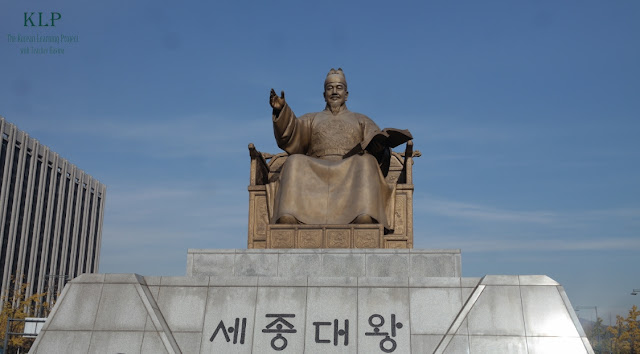

King Sejong Statue - In Jong-ro, the middle of Seoul
: Picture taken by Teacher Havina


 1) King Sejong didn't invent Hangeul, only because he 'loved' the people so much.

 It is right. King Sejong is one of the most beloved king among Korean people even until now - which is why his statue is in the middle of Seoul and his face is on 10,000 won. It's because of his numerous works and invention for the people, to make their lives better - not just Hangeul, the language, but he had progressed and evolved a lot of fields during his era : language, science, politics, laws etc.
 Hangeul also has the same purpose. He did make it to help people to live better lives. By using Hangeul, a lot of Hanja-written agricultrual books, ethic publications and Buddhist scriptures were able to be translated and supplied to the people. These books helped people to study and live better quality of lives. Yet, it was not the 'only' reason he had created the new letter. There is more story than just that.
 Hangeul was made to proceed the administration procedures faster. Back then, most of the people didn't know the letter, so the speed of the processes were quite slow. When collecting the taxes - back then, government had attached the posters on the walls to let people know when and how much will be collected as the tax, handling the lawsuit and registering family etc, 'writing and reading' were always required. There were few people who know how to read and write, so most of the people needed to accompany the 'translator' or the 'helper' whenever they are handling the procedures that requires reading and writing. The slow speed of the process was inevitable.
 This will surely be changed if people know how to read and write 'on their own'. They can deal with their own problems or obligations by themselves, which will definitely make the process a lot faster. And it did. Invention of Hangeul had helped to speed up the process of administration procedures and let people know what they are dealing with. It had became the 'medium' of communication between the upper class - more like the government - and the subjugated class. Not to mention, it made much easier and quicker for the government to collect the taxes from people without any useless time wasted during the process.


Origin of Hangeul - Carved under the King Sejong's statue
: Photo taken by Teacher Havina


 2) Hangeul was never welcomed in the first place.

 Like it was mentioned before, Hangeul is an easy, scientific letter that can be read and written easily by any person, from any kind of class and it was created by 'King' Sejong. This letter had all kinds of conditions to be welcomed by all of the people in Joseon Dynasty. However, it did not. When its existence of Hangeul was first notified to the public on 1443, the upper class, including many government officials and scholars, strongly disagreed to its use. How could this happen? Why would hierarchy want to disagree to such a good opportunity to enlighten their own people? There are two main reasons why they disagreed.
 Hangeul was 'King Sejong and his people's' project. King Sejong was not the 'only' person who made Hangeul. The idea and 28 letters - at first, as Hunminjungeum, there were 28 letters and not 40 letters - of Hangeul were invented by King Sejong, though the rules, such as pronunciation or use of each letter, were not 'entirely' made by King Sejong. Invention of Hangeul was more like the 'royal family project'. King Sejong's son and daughters, prince and princesses during that era, had participated in this huge project. Only few of the scholars were in this project, who were mostly young and new; they stepped into the project only after the letter was fully created. Also, most of the jobs that these scholars did, are 'translating' the Hanja-based books into Hangeul, and not creating the letters nor its rules. Even for these processes, the translating, the princes, sons of King Sejong, were in charge as the leader.
 This is the first factor why it was not welcomed by most of the government officials. It was not the letter that was 'co-produced' by the bureaucrats and the king. Invention of the letter was more like King Sejong's solo-action with his 'own people'. Therefore, after the invention of Hangeul was announced, there were tons of objections from the vassals. Their main reason was : Joseon should not use the different letter system from China, because Joseon was the subordinate country of China. Thus, it was only the 'outer reason' and moral obligation they insisted on to make their opinion seemed reasonable. However, the 'real reason' of their opposition was to prevent the royal authority to become even more stronger.
 This becomes clearer if we look into the books that King Sejong ordered his people to translate. The first several books that they had translated was about the Confucianism and the story about how Joseon and royal family was first started. Confucianism was the religion of the Joseon Dynasty. Spreading its main ideology to people will unify and bond them to make a 'stronger' society. Not only that, letting people know the origin of the country and the royal family will justify the country's existence and can make them look up to the royal family and the King himself as well. This will result more power to the royalty and less to the vassals.
 King Sejong must be either a 'sage' king who loved his people or a clever 'politician', or both - the opinion I would like to address, I personally think he was both. However, one thing is clear : due to this underlying political reason, there were lots of opposite opinions from the upper class about using Hangeul. The result? As you've already guessed, King Sejong was able to calm down the vassals - like I said, he was the clever politician as well as the sage king - and let Hangeul be used and spread among the people.
 Hangeul was never fully welcomed to the upper class until Joseon Dynasty was vanished; it is called as 'women's letter' or 'Eonmun' among the upper class to lower the value of Hangeul. Thus, it was constantly and popularly used among the subjugated class, to inform others about the governments' misbehavior and to instigate others to take action or join in the demonstration or even the revolution.
 Hangeul was eventually accepted by 'all' Koreans in 1913, with the name of 'Hangeul' and finally be welcomed as the 'official letter' of Korea.


- More Links -


1. Want to know more about Hangeul, the Korean alphabet?

2. Want to know how Hangeul is formed?

3. Want to learn about the Korean alphabet?


Check out THIS PAGE!


  Video and pdf file will be provided about Hangeul, the Korean alphabet.



2016년 3월 2일 수요일

Pre-B 6. Korean verb ( 한국어 동사 )


1. Video : Watch here! :)


2. PDF : Read & Download here! :)
  - Read & Download the file on THIS LINK (Google Drive)